Winter Car Rides with a Small Dog in Hokkaido: Safety and Comfort
Contents
- Never leave your dog in a parked car
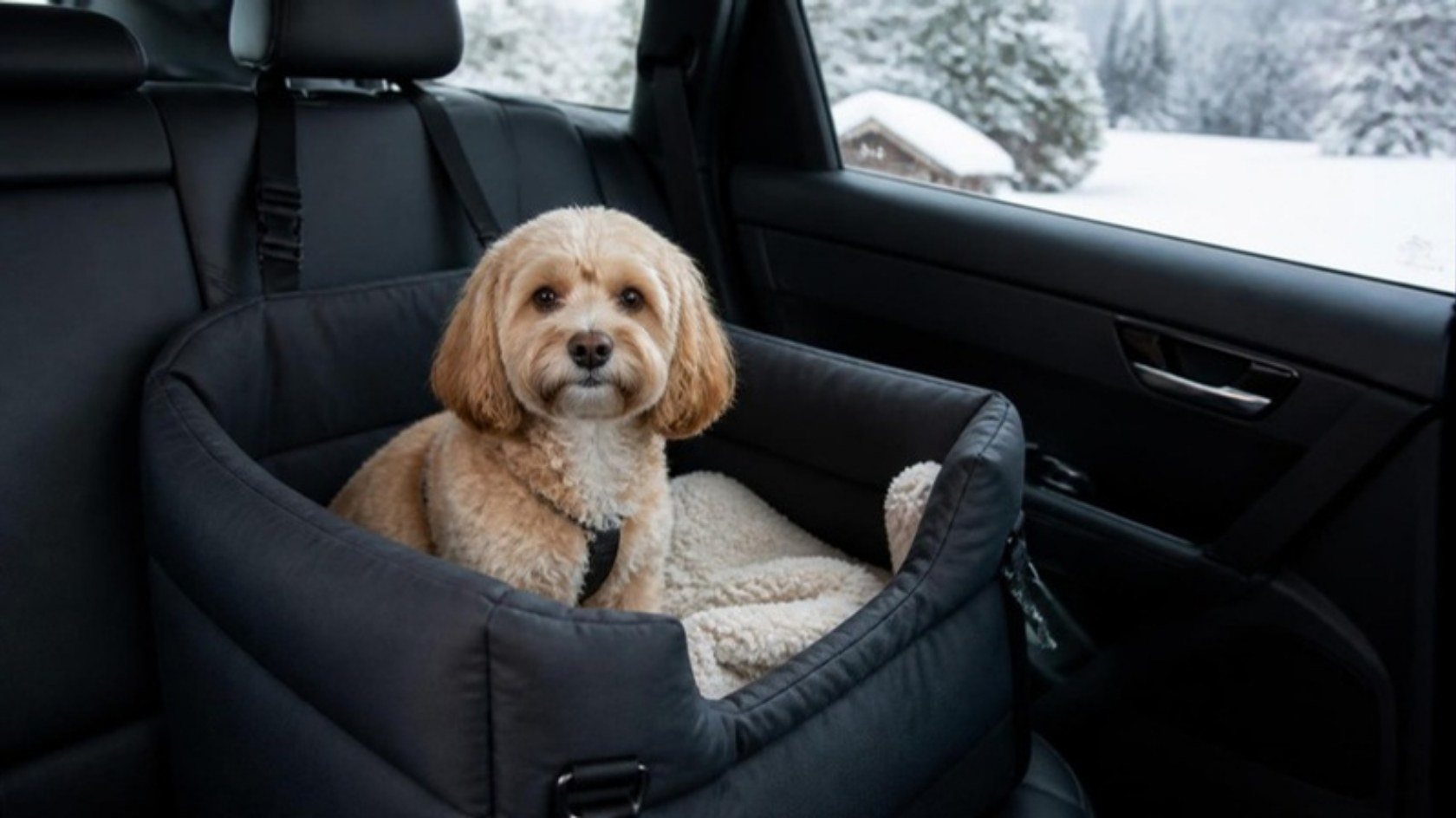
- Give your dog a fixed place to ride
- Carbon monoxide: when the car is buried in snow
- Comfort on winter drives
- A short winter car checklist
- FAQ
- Is it OK to leave my dog in the car for a few minutes in winter?
- How should a small dog ride in the car on winter roads?
- What should I do if my car gets stuck in snow with my dog inside?
In short: on winter car rides in Hokkaido, never leave your small dog alone in a parked car. In a JAF test, the inside of a car with the engine off dropped to 1.8°C within a few hours on a night of about −11°C. Give your dog a fixed place to ride, such as a secured crate or a car harness clipped in as the maker directs. If your car gets buried in snow with the engine running, exhaust can get inside: in another JAF test, carbon monoxide reached 400 ppm in 16 minutes when snow covered the exhaust pipe, while almost none was detected once the snow around it was cleared. Keep the exhaust clear, turn the engine off when you can, and pack blankets and a shovel.
Snowy roads, short days, and cold parking lots make winter drives a little different. This post covers what to check before you set off with a small dog, and what to do if the snow piles up around your car.
Please read this first: this post is a set of general ideas for winter car rides. It is not about my own dog, and it is not expert advice. I am not a veterinarian, and I can’t judge your dog’s body or health. The tests below were done by JAF with cars and adult people, not with dogs. If you are not sure whether winter car trips suit your dog, or if anything about your dog’s health worries you, please ask your vet.
Never leave your dog in a parked car
The rule is the same in every season: don’t leave your dog alone in a parked car, not even “just for a few minutes.”
RSPCA Australia, an animal welfare organization, says plainly: “Never leave your dog unattended in a car.” It adds that dogs can very quickly suffer from heat stress “even in mild weather,” so the rule is not only for summer.
Cold is the other risk in a Hokkaido winter. JAF, the Japan Automobile Federation, tested how cold a car gets with the engine off on a winter night.
| JAF winter test | What JAF reported |
|---|---|
| When and where | February 4–5, 2014, overnight, at Sugadaira Highlands in Nagano Prefecture |
| Outside temperature | −10.2°C at the start, with a low of −13.2°C |
| Setup | The car was heated to 25°C, then the engine was turned off for 8 hours |
| Adults with no extra gear (no blankets, heat packs, or sleeping bags) | Gave up after 2 hours 45 minutes, with the inside of the car at 1.8°C |
| Adults with blankets and disposable heat packs, or winter sleeping bags | Lasted the full 8 hours, with the inside of the car at −7°C at the end |
These were adults. A small dog left alone in a cold car has no way to ask for help. If your dog can’t come with you, have someone stay with your dog, or change your plan.
Give your dog a fixed place to ride
A loose dog can distract the driver, and in a sudden stop it can be thrown forward. On icy roads, where you may brake or slide without warning, a fixed place to ride matters even more.
RSPCA Australia lists the benefits of restraint: the dog can’t move around and distract the driver, may be less likely to become a projectile if you brake hard or crash, and can’t jump out of a window.
| Option | What RSPCA Australia says to check |
|---|---|
| Car harness | Use one made for vehicles that has passed safety or crash tests, in the back seat, attached as the maker directs, usually to the seat belt. A car harness may be different from the one you use for walks |
| Crate or carrier | Secure it inside the car, choose one that has passed safety or crash tests, and make sure it has good airflow and room for your dog to stand, turn around, and lie down |
| Cargo barrier | May protect people from the dog in a crash but may not protect the dog, so a restraint may also be advisable |
A few habits for winter:
- Keep your dog off your lap and away from the pedals and the gear lever.
- Clip the harness or close the crate before you open the car door, so your dog can’t jump out onto a snowy, slippery parking lot.
- Practice in short drives before a longer winter trip. My post Carrier Training for a Small Dog: A Step-by-Step Guide walks through small steps, from leaving the carrier out at home to short rides.
Carbon monoxide: when the car is buried in snow
This is the winter risk many people don’t expect. JAF explains that exhaust contains carbon monoxide (CO), a gas with no color and no smell, so it is hard to notice. If snow blocks the exhaust pipe while the engine runs, exhaust can get inside the car, even through gaps in the body.
JAF tested this in Hokkaido.
| JAF carbon monoxide test | What JAF reported |
|---|---|
| When and where | February 16, 2015, in Asahikawa, Hokkaido |
| Setup | Two identical cars with the engine running, with snow piled up to the height of the exhaust pipe |
| No measures | CO began rising right away, reached 400 ppm (the short-term exposure limit) after 16 minutes, and reached the 1,000 ppm measurement limit 6 minutes later |
| Snow cleared around the exhaust | Almost no CO was detected throughout the test |
| A window opened about 5 cm | CO rose into the 100 ppm range within 5 minutes, reached 400 ppm after about 40 minutes, and soon went above 800 ppm |
JAF also found that exhaust collecting under the car was drawn into the cabin, and it notes that conditions such as wind direction and air-conditioner settings can change the results, so a setup that was safe in its test could still be dangerous.
A later JAF test, described in JAF Mate, buried a car up to about the height of the door handles with the exhaust pipe fully covered. CO inside reached the detector’s warning level of 50 ppm just 1 minute 24 seconds after the start.
What JAF recommends if you get stuck in snow:
- Turn the engine off as much as you can while snow is falling.
- Clear the snow around the exhaust pipe regularly if you need to run the engine for heat.
- Let fresh air in from time to time.
- Don’t go outside in a severe blizzard if that is dangerous in itself. In that case, JAF says to ventilate and turn the engine off.
- Keep warm things in the car, such as blankets, plus a shovel, boots, and gloves for clearing snow.
Remember that your dog may be riding low in a crate or on the floor, and it can’t tell you something is wrong. If you think a person in the car is unwell, get fresh air and call emergency services. If you are worried about your dog after an incident like this, contact your vet right away.
Comfort on winter drives
Safety comes first, but a few small things can make a winter ride easier for a small dog.
- A familiar blanket in the crate or on the seat.
- Warm, not hot. Keep the car at a comfortable temperature, and don’t point a heater vent straight at your dog.
- Towels for snowy paws, so snow and slush don’t soak the seat or the crate.
- Water and short breaks on longer drives. Put your dog’s leash on before you open the door.
- A coat, if your dog wears one, for breaks outside. Some owners take it off in a warm car.
My post Hokkaido Road Trip with a Small Dog: A Planning Checklist covers rest stops, Michi-no-Eki roadside stations, and longer drives. For the rest of the season at home, Your First Sapporo Winter with a Small Dog: A Simple Checklist may help.
A short winter car checklist
| Before you go | Why |
|---|---|
| Check the weather and road information for your route | JAF Mate suggests checking the forecast for your destination and route before going out in snow |
| Pack blankets, a shovel, boots, and gloves | For staying warm and clearing snow if you get stuck |
| Secure the crate or clip in the car harness | A fixed place to ride on slippery roads |
| Bring towels, water, a leash, and waste bags | For snowy paws and breaks |
| Plan so your dog never waits alone in the car | A parked car can get very cold, and RSPCA Australia warns about heat even in mild weather |
Never leave your dog in a parked car, give it a fixed place to ride, and keep the exhaust pipe clear if snow piles up around your car. Pack for the cold, check the roads, and if something about your dog’s health worries you, ask your vet.
FAQ
Is it OK to leave my dog in the car for a few minutes in winter?
No. In a JAF test on a night of about −11°C, the inside of a car with the engine off dropped to 1.8°C within 2 hours 45 minutes. RSPCA Australia also says never to leave a dog unattended in a car. If your dog can’t come with you, have someone stay with it.
How should a small dog ride in the car on winter roads?
In a fixed place. RSPCA Australia suggests a car harness that has passed safety or crash tests, used in the back seat and attached as the maker directs, or a crate that is secured inside the car, has good airflow, and lets your dog stand, turn around, and lie down.
What should I do if my car gets stuck in snow with my dog inside?
Turn the engine off when you can, and if you need to run it, clear the snow around the exhaust pipe regularly and let fresh air in. In a JAF test, CO reached 400 ppm in 16 minutes when snow covered the exhaust, while almost none was detected once the snow around it was cleared. If you are worried about your dog afterward, contact your vet.
Sources checked: JAF, クルマが雪で埋まった場合、CO中毒に注意 (carbon monoxide when a car is buried in snow, user test) (Japanese), JAF, 雪で埋まった場合の一酸化炭素中毒の危険性とは? (Q&A on carbon monoxide in snow) (Japanese), JAF, 冬の車内温度 (winter car interior temperature test) (Japanese), JAF Mate Online, 大雪で立ち往生! 車が雪に埋もれたときの車内環境はどう変わる? (February 12, 2026) (Japanese), RSPCA Australia Knowledgebase, “Do I need to restrain my dog when travelling in my car?”. Checked on October 7, 2026. Advice and test results can be updated, so please check the latest information.